Wednesday, April 25, 2012

The 'Birding Journo Gods'


A special week for all the birding businesses from the Bird Trails Tropical Queensland group in Tropical North Queensland, with a week's visit to the region from a group of international birdwatching journalists. We all had the opportunity to host them and, all in all, they had a fabulous time.
We decided that the 'Birding Journo Gods' were watching out for us when they arrived in Daintree. After a few days of miserable rain, the sun came out and so did the birds.
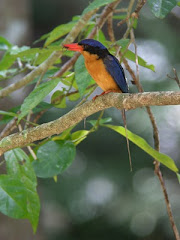
A quick drive to the end of Stewart Creek Rd gave us some of our best birds with Buff-breasted Paradise Kingfisher, Azure Kingfisher, Little Kingfisher, Yellow-breasted Boatbill, Victoria's Riflebird, Pied Monarch, Lovely Fairy-Wren, Cicadabird and many many more birds in feeding flocks, working their way through the forest. Couldn't get the grins off our faces!!

Hugh, Ed, Trish and Mike - Stewart Creek Rd
A fabulous couple of weeks for birdwatching in Daintree generally, with good regular views of Great-billed Heron on the Daintree River, a family of four Black-necked Stork on the banks of the river, Red-necked Crake, Pied Monarch and Little Kingfisher at Red Mill House, Cassowary sightings near Cape Trib and Little Eagle in the Daintree Valley.
All good, really!

Sunday, April 1, 2012

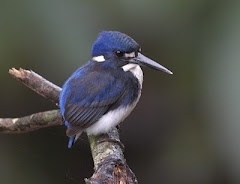
Little Kingfisher is back!

After disappearing for a few months over the Wet Season, the Little Kingfisher has returned to the pond in the garden at Red Mill House.
Australia's smallest kingfisher, and probably the most elusive, this bird is a target species for many birdwatchers visiting tropical north Queensland, and Daintree in particular.
This lovely photo, taken last year by JJ Harrison from Tasmania, shows the Red Mill House Little Kingfisher looking more like a Puffin than a Kingfisher with his mouthful of fish!


The Little Kingfisher is a bird of lowland rainforest streams, preferring dark, narrow spaces with overhanging vegetation. It may also inhabit lakes, estuaries and coastal mangroves. It perches low, plunges deeply into the water for fish and small crustaceans and returns to perch. It will often bob it's head and wings while watching for prey. 

Friday, March 2, 2012

The Daintree River

After 9 years of enjoying the Daintree River from the outside,and only occasionally up-close, the Red Mill House crew have bought a little 'tinny' to enable us to spend more time on the river during the quiet times.
It's a beauty - 2 seats, 20HP motor, a full biminy roof and depth-sounder - everything we need bar a pair of binoculars and fishing rod!


Andrew and his 'liner'
 How wonderful it has been to drift down Barratt Creek looking at nests, into the by-wash for kingfishers, and way upstream to see Magpie Geese on the banks. It has been fun trying to spot tree snakes and water dragons and trying not to spot crocodiles that are longer than the boat!
The Daintree River has always been the best place to see wildlife and and in the past couple of weeks we have seen most of the target species for the area - Great-billed Heron, Little Kingfisher, Azure Kingfisher, Black Bittern, Black-necked Stork, Cicadabird, Wompoo Fruit-Dove, Double-eyed Fig-Parrot, Shining Flycatcher, Channel-billed Cuckoo and many more.
Further downstream we make our way into the varied mangrove habitats of the Daintree River.


 Toward the ferry crossing a female crocodile named 'Lizzie' recently hatched her babies, and on this day up to 13 hatchlings has been sighted. They stay close together for the first few days and then will start to disperse.

3 day old crocodile
We're looking forward to discovering and learning more about the Daintree River during this 'wet season'

Tuesday, February 14, 2012

Double-eyed Fig-Parrots

They are Australia's smallest parrot: are green, have a short tail, are about the size of a leaf, look like a leaf, and unless you see them land, are extremely difficult to see well. Most times it is 'chit, chit, chit' as a stubby, green flash flies overhead. A 'flying green potato' is a good description.

The Double-eyed Fig-Parrot usually excavates it's own nest in the dead extremities of  trees, and as the top breaks off, it will move it's way further down the tree until the usefulness of the tree is finished. Often a tree will be used for several years. You can see some shallow excavations in this photo of the male.

Double-eyed Fig-Parrot  (Keith Fisher - Kingfisher Park)
One such tree along Stewart Creek Rd came down in a storm last week and it was fascinating to see what a large cavity it creates for it's nest. The bird is only 13 cm in length, and the entrance is tiny, but the cavity is much bigger and beautifully formed.


This year seems to have been a particularly good breeding season for these birds.

Tuesday, January 31, 2012

The Wet Season

While rain has been intermittent, it certainly feels like the wet season in Daintree.
Warm, humid and with the ever-present feeling of 'it's going to rain soon'. 380mm in January, so a gentle start to the year. We have just returned from Western Australia where it was 42 degrees every day (dry, dry heat), so it's nice to be home.
A real treat in the garden at Red Mill House yesterday while pruning - a beautiful, huge Northern Barred Frog  (Mixophyes schevilli). Note the barring on the legs and the fully webbed toes. It is an adult man's hand that it is sitting on, so - rather large!
Northern Barred Frog
 Another treat for the week is the continued presence of the Spotted Whistling Ducks ( a Philippines/PNG species) of which a group of 11 or so have been frequenting local ponds and dams and waterways over the past few months. Every time you think they have gone, they re-appear.
A terrible photo I know, but at least I know I have seen them!
Spotted Whistling Duck
Pied Monarch in the garden today, and Buff-breasted Paradise Kingfisher still busy along Stewart Creek Rd. Lots of Channel-billed Cuckoos and Double-eyed Fig-Parrots this year.

Friday, January 13, 2012

New Year's resolution - blogging!!

Where does the time go?
My apologies for such a long absence - I was embarrassed to receive blog stats recently and see many people are looking at this blog, but that I have done nothing for such a long time. Thank you for your perseverance.

A New Year's resolution - to keep people informed and up to date this year about life and birding in the Daintree.

First things first though.
We have just returned from a wonderful month's holiday in Sri Lanka.
What a great destination for viewing wildlife and  to have the opportunity to meet such wonderful people who are happy to share their ancient, rich and diverse land with us. We took part in a private Birdwatching and Wildlife tour for 11 days, then spent another 2 1/2 weeks exploring the island by various means.
Many, many photos, but this is a favourite!!


Sri Lanka is experiencing a tourist boom, now that the conflicts are over and the rebuilding from the 2004 Tsunami is virtually complete. It is an easy and safe destination and very popular with northern Europeans at this time of year - why wouldn't it be? Wildlife tourism is also growing quickly, and we would recommend going sooner, rather than later, as there will probably be greater demand in the future, stretching the resources of the good nature guides and companies.
We travelled with, and would recommend Prasanjith Caldera from Walk with Jith, an excellent guide and organiser, who created the perfect tour for us, at a very good price. His other guides, Sam and Nandana, were also charming and knowledgeable and we enjoyed them all.
If you would like any more details, please just contact Andrew or Trish at Red Mill House.

So, back to Daintree - - and what a beautiful place at this time of year. To date, little rain and few mosquitoes, so everyone is happy.
The summer migrants are all here, with Pied Imperial Pigeon very common, flocks of Metallic Starlings feeding on forest fruits, Black Bittern on the Daintree River, and most spectacularly, the Buff-breasted Paradise Kingfisher which are nesting in the termite mounds nearby. We were fortunate to rescue one of these that had been hit by a car recently. He seemed okay, which is great.


A juvenile Great-billed Heron is being seen regularly on the Daintree River, and some visitors have been lucky enough to watch Mum feeding it. Lots of new Double-eyed Fig-Parrots around also. It really is a great time for birding in Daintree.
This is an older photo now, but a classic just the same - taken on the road to Cape Tribulation by guests from Red Mill House late last year.


Another New Year's Resolution is to take more time birding this year. So lots of reports to come!!

Tuesday, May 24, 2011

Night life in Daintree

May is the beginning of the 'winter' months in  Daintree  - cooler nights and misty mornings, followed by beautiful sunny days with temperatures in the mid-20's.
In the cooler nights of late, owls have been calling. Around Barrett Creek the (lesser) Sooty Owl has been calling each night and in the town of Daintree, early morning calls of the Barking Owl have been common.
The Barking Owl, a small Ninox owl, often feeds on small bats which are swooping for insects under the street lights of town. These in turn are feeding on insects drawn to the light. On the ground, under the lights, are bugs, beetles and unfortunately, cane toads.
Last night a pair of Barking Owls called to each other incessantly for an hour or so - quite delightful!


The other favourite with birders is the Rufous Owl - a large (up to 55 cm) owl which swoops with deadly, but silent, precision on roosting birds or even bandicoots on the ground. The garden at Red Mill House in Daintree Village is often the hunting grounds of the Rufous Owl and many a birder has been called out from dinner to watch the spectacle of the Rufous Owl feeding in the garden.