Powered By Blogger

Friday, September 28, 2012

The new Daintree Birdwatching Bulletin


Following the crash of the one existing computer in this house which supported Windows XP, we no longer have access to the Dreamweaver programme from which the Daintree Birdwatching Bulletin was created and maintained.
So - - - this blog is now the new Daintree Birdwatching Bulletin, which means I have to be a bit more vigilant  about keeping it updated!

September is a fabulous time of year in Daintree - warm, sunny, not humid and very few mosquitoes. With a couple of notable exceptions (Buff-breasted Paradise Kingfisher and Black Bittern), all our summer migrants are here. Lots of nesting is going on making some birds like Great-billed Heron and Southern Cassowary more difficult to see, and others like Metallic Starling and Brown-backed Honeyeater are easier.

Good sightings of Little Kingfisher, Double-eyed Fig-Parrot and Pacific Baza in the garden at Red Mill House while Stewart Creek Rd has been handy for Lovely Fairy-Wren and Pied Monarch.

Very good sightings of Noisy Pitta on the track at the end of Cape Kimberly and there has been a very handsome, and somewhat 'friendly' sub-adult Southern Cassowary at Jindalba Boardwalk, as the following photos from Paul McLelland shows us.

Sub-adult Cassowary Jindalba Boardwalk

Sub-adult Cassowary Jindalba Boardwalk - a close look!
A male Cassowary with three chicks is also in the region of Jindalba, and also a large female. Most sightings seem have been early morning and it is has been difficult finding then during the day.

Other Daintree sightings include Topknot Pigeon, Yellow-breasted Boatbill, Victoria's Riflebird and Shining Flycatcher. Check out our weekly sightings list for more details Red Mill House Sightings page

Monday, September 3, 2012

British Birdfair 2012


For the 3rd year in a row the Red Mill House team has organised and run the Australian Birdwatching display at the British Birdfair. A three-day event with over 23,000 people coming through, it is the biggest event of it's type in the world. With 7 display marques, plus three different lecture marques, optics, camera gear, travel companies, conservation groups etc, etc it is a fabulous weekend.
Being the first fine weekend for (seemingly) months, people were out in throngs and everyone had a great time. The mood was upbeat, being just after the very successful London Olympics


Australian Stand 2012
30 birdwatching-related businesses from around Australia were represented at the booth, with lots of requests for tours, guides and accommodation throughout Australia. Unfortunately the continually high Australian dollar has made it difficult attracting the Brits to Australia in the last few years, but it seems they are getting used to the idea and are now talking about visiting anyway. That is a big improvement on last year.

Busy Marque 4
It is non-stop talking for 3 days, but lots of fun.

Tuesday, July 10, 2012

Herons in the Daintree River

Herons are always a great bird to see - often secretive, sometimes bold and confiding.
The Daintree River is famous as one of the more reliable places to see the rather difficult Great-billed Heron, and this month has been no exception. They have been calling (a deep guttural sound) and are developing breeding plumage as shown in the photo below taken early in the month by Russ Jones on the Daintree. Pairs of birds have also been seen, which is a good sign. Last year was a successful season for breeding for the Great-billed Heron locally.

Great-billed Heron (Russell Jones)
 Other Herons on the Daintree River include Nankeen Night Heron and Striated Heron. White-faced Heron  and White-necked Heron are also seen in the Daintree Valley.


Striated Heron (Ian Worcester)
Good views of Black-necked Stork locally as well, completing the sought-after and spectacular large, aquatic species.

Wednesday, June 20, 2012

Southern Cassowary

The local Daintree Region Cassowary Group has been working hard at collecting data on the Southern Cassowary population in the Daintree Rainforest and building of a database of individual birds and their territories.
Fortunately, sightings north of the Daintree River have been frequent and varied recently, and Red Mill House guests have been able to help with data for the group.
Often people get so excited about seeing a Cassowary the photos are pretty ordinary, but Kath Jones from Victoria managed this lovely photo yesterday.


This male and his chick were seen near Noah Creek, and have also been spotted at Maardja Boardwalk in the last few days.
If you come across a Cassowary in the Daintree Rainforest, submit your sighting to DRCG via this weblink
http://daintreecassowary.org.au/submission
The more that is known about them, the better the chance of helping this rare and endangered (and beautiful) bird.

Thursday, May 31, 2012

Beach favourites

A fairly miserable start to our normally-gorgeous-winters this year, with some rain and lots of cloudy days.
It hasn't been such great weather for getting out to The Great Barrier Reef, but there has been some good birdwatching along the beach areas.
Regular sightings of Beach Stone-Curlew are happening along Wonga Beach, at Newell Beach and along Myall Beach.


Restricted in range to the coastal parts of Northern Australia, the Beach Stone-Curlew (or Beach Thick-knee) inhabits the beaches (usually one pair for each beach) and are normally quite shy and easily disturbed. Tidal mudflats and mangroves are other suitable habitats.  They are often a difficult bird for visiting birdwatchers
With huge bills they feed on crabs and other marine invertebrates.

Other recent beach sighting include Collared Kingfisher, Sacred Kingfisher, Pied Oyster-Catcher and Grey-tailed Tattler, along with Osprey and White-bellied Sea-Eagle.

Wednesday, April 25, 2012

The 'Birding Journo Gods'


A special week for all the birding businesses from the Bird Trails Tropical Queensland group in Tropical North Queensland, with a week's visit to the region from a group of international birdwatching journalists. We all had the opportunity to host them and, all in all, they had a fabulous time.
We decided that the 'Birding Journo Gods' were watching out for us when they arrived in Daintree. After a few days of miserable rain, the sun came out and so did the birds.
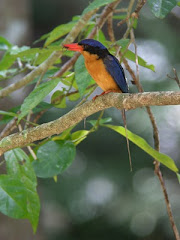
A quick drive to the end of Stewart Creek Rd gave us some of our best birds with Buff-breasted Paradise Kingfisher, Azure Kingfisher, Little Kingfisher, Yellow-breasted Boatbill, Victoria's Riflebird, Pied Monarch, Lovely Fairy-Wren, Cicadabird and many many more birds in feeding flocks, working their way through the forest. Couldn't get the grins off our faces!!

Hugh, Ed, Trish and Mike - Stewart Creek Rd
A fabulous couple of weeks for birdwatching in Daintree generally, with good regular views of Great-billed Heron on the Daintree River, a family of four Black-necked Stork on the banks of the river, Red-necked Crake, Pied Monarch and Little Kingfisher at Red Mill House, Cassowary sightings near Cape Trib and Little Eagle in the Daintree Valley.
All good, really!

Monday, April 2, 2012

Little Kingfisher is back!

After disappearing for a few months over the Wet Season, the Little Kingfisher has returned to the pond in the garden at Red Mill House.
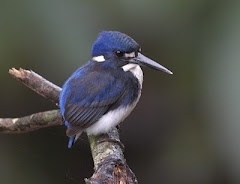
Australia's smallest kingfisher, and probably the most elusive, this bird is a target species for many birdwatchers visiting tropical north Queensland, and Daintree in particular.
This lovely photo, taken last year by JJ Harrison from Tasmania, shows the Red Mill House Little Kingfisher looking more like a Puffin than a Kingfisher with his mouthful of fish!


The Little Kingfisher is a bird of lowland rainforest streams, preferring dark, narrow spaces with overhanging vegetation. It may also inhabit lakes, estuaries and coastal mangroves. It perches low, plunges deeply into the water for fish and small crustaceans and returns to perch. It will often bob it's head and wings while watching for prey.