Powered By Blogger

Saturday, March 5, 2011

The 'wet' season - best for birds!

Apologies for the delay in blogging. We had a month away visiting family and friends in Western Australia - fabulous birds in the south west corner and although we missed the Noisy Scrubbird, we saw many of the endemics of that part of the country. An extremely diverse area in plant life and habitats and well worth a visit. 


February was the wettest on record in Daintree Village with 1640ml of rain, bringing the year's (2 months!) total to 2117ml by the end of the month. We endured Cyclone Yasi who, fortunately for us, crossed the coast south of Cairns, causing minimal damage here in Daintree. Red Mill House, particularly, fared well - it seems the small hill behind us protects us from the strongest winds. The house was built in the 1920s and is still standing in it's original state - great design and great location!

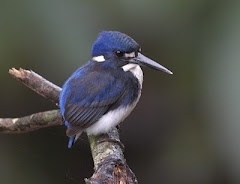
Back in Daintree, the weather has improved and visitors are coming. The 'wet' season is always best for birding, despite the sometimes-rainy conditions. The summer migrants are all still here, including the Buff-breasted Paradise Kingfisher. The Little Kingfisher and Azure Kingfisher are also more visible as the breeding season come to an end. Both have been seen on the pond at Red Mill House in recent days. Also in the garden is Australasian Koel, Double-eyed Fig-Parrot, Wompoo Fruit-Dove, Yellow Oriole and others. A short, late afternoon walk with guests along Stewart Creek Rd from Daintree Village was very productive with Channel-billed Cuckoo, Little Bronze Cuckoo and female Australian Koel, plus a range of birds foraging for insects in the afternoon sun - Grey Whistler, Spectacled Monarch, Leaden Flycatcher, Fairy Gerygone,
Graceful, Macleay's and Yellow-spotted Honeyeater, Mistletoebird, Olive-backed Sunbird, Spangled Drongo, and Varied Triller. Others, chasing fruit, included Brown-Cuckoo Dove, Figbird and Wompoo Fruit-Dove. A lovely walk and great introduction to the UK birders who had just arrived.

Sunday, January 23, 2011

January 2011

After a very wet year in 2010 ( 4.6 metres of rain), it has been a normal start to the year in the Wet Tropics and in Daintree. We would normally expect the 'wet season' to begin at this time of year and to date we have had over 400ml. Evenly spaced, so no flooding - unlike our less fortunate cousins in southern Qld. We seem to be blessed with stable weather patterns in this part of the world.
An excellent trip on the Daintree River for Red Mill House guests this morning with the highlight being the nesting Herons. Both Striated Heron and Nankeen Night-Heron are nesting. The Nankeen Night-Heron feeds at night, hunting for insects, crustaceans, fish and amphibians.


This morning's passengers were also treated to a pair of Great-billed Heron flying, displaying, calling and preening.


The Great-billed Heron is Australia's largest heron and has an enormous bill. It is found in Northern Australia, found in mangroves, tidal mudflats and lowland rivers. It can be found most of the year on the Daintree River and in Barratt Creek and Stewart Creek.

Saturday, December 4, 2010

Family time

By the end of November Daintree had a reached over 4 metres of rain for the year - an extraordinary amount of rain for most of us who were brought up in much drier climes than these! There has only been minor flooding though, but it won't take long once the 'wet season' arrives in a month or so - the ground is well and truly saturated now and will not hold big inundations.
Birding has remained interesting though, with good numbers of summer migrants about. The Buff-breasted Paradise Kingfishers are excavating the termite mounds, Black Bittern have chicks on their nests along the river, and Metallic Starling juveniles are busily helping with the next generation.
Rufous Owl have been seen in the garden at Red Mill House on several occasions in the last month, and a reported family of three Rufous Owl at Jindalba Boardwalk took us out looking for them early one morning. No owls, but a lovely Southern Cassowary family, dad with two chicks, not worrying about us at all as they slowly moved through the forest feeding on fruits. A wonderful sight! A good ten minutes of watching before they wandered off.

Sunday, November 7, 2010

Paradise Kingfishers - colourful and stunning.


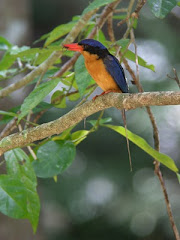
One of the great joys of spring in Daintree and the Wet Tropics is the return of the Buff-breasted Paradise Kingfisher from New Guinea every year to breed. Arriving in late October ( a little early this year), they call madly for mates from high in the forest  for the first few weeks, making them easy to locate. They will soon settle down to nest in the terrestrial termite mounds on the forest floor of lowland and mid-level rainforest.

Photo by Lynne Perree 2010
The colours are extraordinary, with a bright red bill and red feet, a bright orange breast, bright blue back and head with black markings, and a long white tail and patch on the rump. As the bird calls the tail flicks up and down, and is often the first thing you see.
This bird is a favourite with visiting birders and we locals alike, and they can be seen and heard at the moment along Stewart Creek Rd in Daintree.

Monday, October 18, 2010

Birds and other creatures


The garden at Red Mill House has been a treat for birders in the last couple of weeks with many of our trees fruiting and flowering. Wompoo Fruit-Dove, Double-eyed Fig-Parrot, flocks of Metallic Starling and Spotted Catbird are all enjoying the fruits.
The unseasonal rain throughout the winter and spring means lots of green, lots of new growth and lots of insects and other creatures about. Spotted in the garden yesterday, having just devoured a very large spider was this Boyd's Forest Dragon.


A rainforest species, this dragon can be difficult to see. Often sitting perfectly still on the side of a tree trunk, they are easily missed. We were lucky to see this one feeding and with this posture.

Butterflies have been abundant with all the rain, plus some spectacular moths. This Lyssa spp moth has a wingspan of about 14cm, as seen by the comparison with the book, and a beautiful swallow-tail form.


Saturday, October 2, 2010

Unseasonal conditions

Normally the months of July, August and September are perfect in Daintree - dry, clear and sunny weather. Not so this year. Apart from a few days here and there, it has been a very wet 'dry season'.
The paddocks are green and lush, the dams and wetlands are full, there is lush new growth on the rainforest trees, the lawn needs mowing weekly and the birds and other animals seem to be nesting and breeding early.
None of this stops good birding though!
A return visit from one of our favourite Japanese birders, Yoshihito Tanaka, last month has supplied us with a range of new photos, including this classic of a Wompoo Fruit-Dove with chick.


Sightings on the Daintree River include Black Bittern, Great-billed Heron and Papuan Frogmouth - all starting to nest it seems. Double-eyed Fig-Parrot have been spotted feeding young, and immature Black Butcherbirds are noisily searching for food.

Thursday, September 23, 2010

Birdfairs

In the past month the Red Mill House team have been involved in displays at both the British Birdfair in Rutland UK and the Australian Birdfair in Leeton NSW, and have very much enjoyed the experience.
Representing Australian Birdwatching in the UK, we had a 3m by 6m area decked with fabulous images of Australian birds and with the brochures of 33 businesses/organisations from around the country.


Nearly 23,000 people attended the event over the three days, most of whom are birdwatchers. Displays ranged from tourism products to conservation groups, artists to book sellers, optics suppliers and many more, all in 7 huge marquees.There were also two lecture marquees running flat-out for the weekend, as well as entertainment and scheduled events. HUGE!! We had a great time catching up with old guests and meeting and talking to large numbers of people, encouraging them to visit Australia for their next birding holiday. It was a busy time.


The Australian Birdfair, held in Leeton each year, is in it's infancy still. Not huge numbers of people, but those who attended were very committed. Again, a lecture programme with excellent speakers and diverse topics, plus tours and displays. Andrew and Keith from Kingfisher Park represented Birding in Tropical Queensland and generated good interest amongst the birders present.
We are hoping to attend both these events again next year.