Powered By Blogger

Thursday, July 8, 2010

Holiday Season

July is the busiest time of the year here in Daintree with visitors from the cold southern states of Australia plus those from the northern hemisphere who have summer holidays. It's great meeting so many varied people from around the world.
One of the joys of birdwatching (and meeting people) is introducing people to our local birds and increasing their awareness and appreciation of our feather friends and our local environment. Andrew and I particularly enjoy helping young people to develop their interest in wildlife. It's great to meet seven year olds who know the difference between a male and female Figbird! The Cribb kids from Cunamulla were perfect examples of aspiring birders.


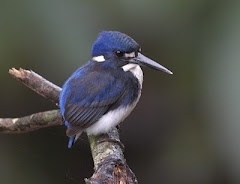
The gardens of Red Mill House have been excellent for several birds in the past week - Spotted Catbird, Victoria's Riflebird, Double-eyed Fig-Parrot, Azure Kingfisher and Little Bronze-Cuckoo plus all the usual suspects.
There is also a variety of doves and pigeons around at present with flocks of Top-knot Pigeon flying through and Wompoo Fruit-Dove, Brown Cuckoo-Dove, Emerald Dove and Bar-shouldered Dove in the garden
The Emerald Dove is a lovely unassuming bird who feeds on the forest floor generally and camouflages well with it's bronze and emerald green tones which change with the light.

Saturday, June 26, 2010

The 'Dry' Season

Winter is the best time for seeing Monarchs in the coastal lowlands of the Daintree. The most common is Spectacled Monarch who can be seen and heard easily in many habitats. They are very active chasing insects and will often be seen with other insect eaters such as Little Shrike-Thrush. They love to bathe in birdbaths in domestic gardens.


The Pied Monarch is one of the Wet Tropics' 12 endemics and is found in both the lowlands and the upland areas of the Cairns Highlands. It is also easier to see in winter as a rule.The distinctive habit of running up, down and around tree trunks searching for food, plus the distinctive markings, make identification easy.


Both these birds have been in the gardens of Red Mill house in Daintree Village in the past few days.

Monday, June 7, 2010

Winter Magic

Glorious weather in Daintree, making it the perfect time of year to visit. Lots of campervans and caravans about as winter descends on Southern Australia, but we still have 27 degree days and start complaining if the night-time temperature drops below 17 degrees.
Some great winter birds about with flycatchers, monarchs and fantails being more obvious foraging for insects in the morning and late afternoon light. Spotted Catbird and Victoria's Riflebird (female) are also easier to see at this time of year.  A favourite, Lovely Fairy-Wren, is also reasonably easily seen along Stewart Creek Rd - a family group of five, including one gloriously coloured male.
The Blue Quandong fruit are maturing up, making great food for the Wompoo Fruit-Dove. Despite being remarkable colouful with it's purple breast and gold flashes on the wings, the Wompoo has the ability to disappear into the foliage. A beautiful bird, particularly when you catch it in the sunlight.

Thursday, May 27, 2010

A glorious time of year

Warm, dry, gorgeous autumn weather with cool nights, misty mornings and glorious days. (And the mosquitoes have disappeared!)
Some great birds in Daintree this week.
A short visit to Jindalba Boardwalk today gave us great views of the Noisy Pitta, with at least three birds heard or seen. As often happens, the carpark area is better than the boardwalk, with Rose-crowned Fruit-Dove and Pale-yellow Robin seen as well. It is always worth taking some time at Jindalba.

Lovely views of a Barking Owl in the early hours on the Mossman Daintree Rd during the week - presumably feeding from the canefields.


The sugarcane harvest season will start within the next couple of weeks and there is always increased activity of raptors over that time. A Wedge-tailed Eagle, Australia's largest eagle, was seen in the same area a couple of days ago.Not a usual sighting for the wetter lowlands.
Pied Monarch, Lewin's Honeyeater and Spotted Catbird in the garden at Red Mill House - all good signs that winter is on it's way.
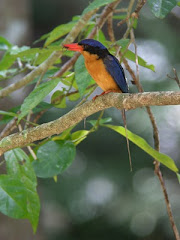
Great-billed Heron seen fishing in the shallows near the bridge along Stewart Creek at low tide and Blue-winged Kookaburra on the wires in Daintree Village.


Saturday, May 8, 2010

Autumn news and weather

At last the sun is shining and the ground is drying out. Perfect weather returns to Daintree.
Some excellent birdwatching locally in the Daintree Valley with lovely views of large numbers of Rainbow Bee-eater and Forest Kingfisher feeding from the fences and posts along Upper Daintree Rd. Sharing their space is the lovely little White-breasted Woodswallow - a very sociable species who often nest in the top of fence posts.


As the local wetlands (and puddles in the paddocks) start to dry out a little we are seeing Royal Spoonbill, Great Egret, Little Egret and Black-fronted Dotterel in the fields.A colouful resident (and migratory) shorebird which inhabits freshwater ponds, puddles and mud. A pair have settled in around a small pond and lots of mud along Upper Daintree Rd.


An escape for the Daintree Birdwatching team yesterday as we had a day birding the dryer country around Julatten, Mount Molloy, Mareeba and Mount Carbine. Over 85 species for the day with some classic Australian birds that we never see here like Galah, Australian Magpie, Pied Butcherbird, Apostlebird and many others. A great day!

Wednesday, April 21, 2010

The serious rains seem to have finished for the season -we have had 2.88 metres of rain for the year to date, so are pleased to have had good 'wet season'.
Some great birds about Daintree in the past couple of weeks.
Great views of Channel-billed Cuckoo (30+ birds) flying around Daintree Village -they should start to disappear soon as the season changes. Black Bittern is a still a regular on the Daintree River, as is Great-billed Heron, Shining Flycatcher and Large-billed Gerygone.
New additions for the new season include Lewin's Honeyeater and Satin Flycatcher. Little Kingfisher has returned to the pond of Red Mill House as a regular visitor, along with the Azure Kingfisher
The last of the juvenile Buff-breasted Paradise Kingfishers seem to have left the Daintree Valley for New Guinea (where they have never been before, and have no guidance to as the adults left a couple of weeks ago! The joy of nature.)
The Orange-footed Scrubfowl, a very successful species of mound builders, seem to be particularly busy at present tending heir mounds and enjoying the drier conditions.

Tuesday, April 6, 2010

Rain, rain and more rain

Daintree has received over 1 metre of rain in the past 12 days! 318 ml on Saturday alone. It's tough - so sloshy underfoot, mould growing on everything, nothing dries, the river, creeks and roads are flooded, people get stranded, landslides and trees coming over because the soil is so waterlogged. Nothing major really, but we feel like we are ready for a break!
The poor old birds are feeling it as well as the nectar and fruit supplies are so much less available. Two of most endearing local birds are also two of the most enduring, despite the conditions.
Any moment the Olive-backed Sunbird sees a break in the weather, they are straight into the ginger flowers for nectar.  The male is particularly beautiful.


The Rainbow Lorikeet is another fabulously busy bird who will eat fruit or nectar (they have specially developed brush like tongues) and adapt well to any conditions.


Big groups of Channel-billed Cuckoos about in Daintree at present, sharing the tops of the trees with the large numbers of Spectacled Flying Foxes that seem to surviving 'the wet' as well.